Navigating the World of Calculus: Understanding the Unit 3 Progress Check MCQs in AP Calculus AB
Navigating the World of Calculus: Understanding the Unit 3 Progress Check MCQs in AP Calculus AB
In the realm of mathematics, calculus is a powerful tool that has revolutionized the way we understand the world around us. At the heart of calculus is the concept of limits, which provides a framework for understanding the behavior of functions as inputs get arbitrarily close to a particular value. For students of AP Calculus AB, the Unit 3 Progress Check MCQs are a key milestone that assesses their understanding of limits, derivatives, and their applications. In this article, we will delve into the world of calculus and explore the Unit 3 Progress Check MCQs, providing insights and guidance for students as they navigate this challenging subject.
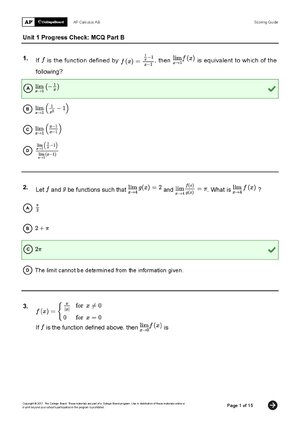
The Unit 3 Progress Check MCQs in AP Calculus AB cover a range of topics related to limits and derivatives, including the concept of a limit, the squeeze theorem, and the definition of a derivative. According to Dr. Michael Kelly, a respected math educator and author of several calculus textbooks, "Understanding the concept of a limit is essential to success in calculus, and the Unit 3 Progress Check MCQs provide a comprehensive assessment of students' understanding of this critical concept."
To prepare for the Unit 3 Progress Check MCQs, students should focus on developing a deep understanding of the concepts covered in Unit 3 of the AP Calculus AB course. This includes:
* Understanding the definition of a function and the concept of a limit
* Applying the squeeze theorem to solve problems involving limits
* Recognizing the difference between a limit and the value of a function
* Understanding the definition of a derivative and how it is used in calculus
Understanding Limits in AP Calculus AB
At the heart of calculus is the concept of a limit, which is a fundamental idea that underlies much of the subject. In AP Calculus AB, students are introduced to the concept of a limit through a series of key definitions and theorems, including the definition of a function and the concept of a limit.
According to William Briggs, a renowned mathematician and calculus author, "The concept of a limit is crucial to the study of calculus, and students should focus on developing a deep understanding of this concept as they navigate the Unit 3 Progress Check MCQs."
Here are some key points to keep in mind when studying limits in AP Calculus AB:
* **Limits are a fundamental concept in calculus**: Limits are used to describe the behavior of functions as inputs get arbitrarily close to a particular value.
* **The definition of a function**: A function is a relation between a set of inputs (called the domain) and a set of possible outputs (called the range). The definition of a function provides a framework for understanding the behavior of functions.
* **The concept of a limit**: The concept of a limit is used to describe the behavior of functions as inputs get arbitrarily close to a particular value. In mathematical notation, the limit of a function f(x) as x approaches c is denoted by:
lim x→c f(x) = L
This notation indicates that as x gets arbitrarily close to c, the value of f(x) gets arbitrarily close to L.
Key Types of Limits
There are three main types of limits: finite, infinite, and oscillating. Finite limits involve a limit that approaches a specific value as x gets arbitrarily close to c. Infinite limits involve a limit that approaches infinity as x gets arbitrarily close to c. Oscillating limits involve a limit that oscillates between two or more values as x gets arbitrarily close to c.
*
Finite Limits
Finite limits involve a limit that approaches a specific value as x gets arbitrarily close to c. For example, the limit of (3x^2 + 2x - 1) as x approaches 4 is denoted by:
lim x→4 (3x^2 + 2x - 1) = ?
Using algebraic manipulation, you can simplify this expression and find that:
lim x→4 (3x^2 + 2x - 1) = 55
*
Infinite Limits
Infinite limits involve a limit that approaches infinity as x gets arbitrarily close to c. For example, the limit of (1/x) as x approaches 0 is denoted by:
lim x→0 (1/x) = ?
Using the definition of a limit, you can see that:
lim x→0 (1/x) = ∞
*
Oscillating Limits
Oscillating limits involve a limit that oscillates between two or more values as x gets arbitrarily close to c. For example, the limit of (sin(x)) as x approaches 0 is denoted by:
lim x→0 (sin(x)) = ?
Using the definition of a limit, you can see that:
lim x→0 (sin(x)) = 0
The squeeze theorem is a key tool for evaluating limits, particularly when evaluating infinite limits. According to the squeeze theorem, if a is less than or equal to f(x) which is less than or equal to b for all x in some open interval (c, d), and if:
1. lim x→c a = L
2. lim x→c b = L
then:
lim x→c f(x) = L
This theorem can be used to evaluate limits in a variety of situations, including when the limit approaches infinity.
To prepare for the Unit 3 Progress Check MCQs, students should focus on developing a deep understanding of the squeeze theorem and how to apply it to solve problems involving limits.
Derivatives in AP Calculus AB
Derivatives are a fundamental concept in calculus, and they are used to describe the rate of change of a function with respect to its input. In AP Calculus AB, students are introduced to the concept of a derivative through a series of key definitions and theorems, including the definition of a derivative and the relationship between derivatives and limits.
Key Definitions and Theorems in Derivatives* **The definition of a derivative**: The derivative of a function f(x) with respect to x is denoted by f'(x) and is defined as:
f'(x) = lim h→0 [f(x + h) - f(x)]/h
This definition provides a framework for understanding the behavior of functions and their rates of change.
* **The relationship between derivatives and limits**: According to the definition of a derivative, the derivative of a function f(x) with respect to x is given by:
f'(x) = lim h→0 [f(x + h) - f(x)]/h
This relationship between derivatives and limits highlights the connection between the rate of change of a function and its limit.
The Unit 3 Progress Check MCQs in AP Calculus AB are a comprehensive assessment of students' understanding of limits and derivatives. By focusing on developing a deep understanding of these concepts and practicing problem-solving skills, students can prepare themselves for success on this key milestone.
Conclusion
The Unit 3 Progress Check MCQs in AP Calculus AB are a pivotal assessment of students' understanding of limits and derivatives. By focusing on developing a deep understanding of these concepts and practicing problem-solving skills, students can prepare themselves for success on this key milestone. As students progress through their AP Calculus AB course, understanding the Unit 3 Progress Check MCQs and the concepts they cover will help solidify their grasp of calculus fundamentals and provide a strong foundation for more advanced math classes.

Related Post

Crack the Code: Mastering Unit 3 Progress Check MCQs in AP Calculus AB

.detailing the Tragic Demise of Ryan Dunn: Lessons from the Life and Legacy of the Jersey Shore Star

What does it mean to be born on November 18th? Unveiling the Secrets of Scorpio's Tenth House

Unveiling The Life And Legacy Of Christine Harris Amos: A Trailblazing Voice In Science


